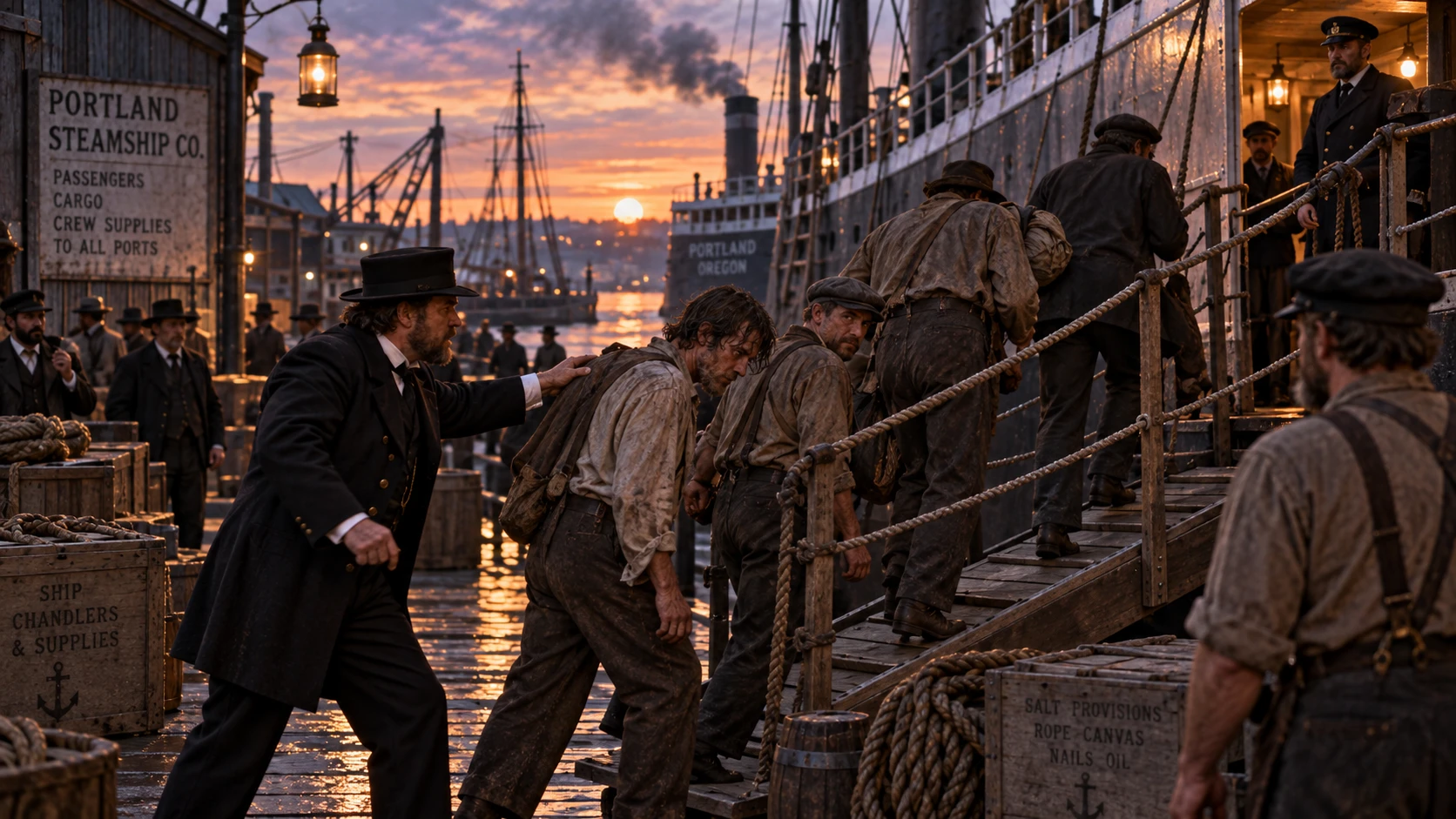
The word sounds almost quaint now.
Shanghaied.
But what it described was not quaint.
It meant a man could be deceived, drugged, trapped in debt, kidnapped or otherwise forced aboard a sailing ship and made to work a voyage he never agreed to take.
Oregon historians have described the practice plainly: essentially kidnapping and enslavement.
Why captains needed bodies
Portland became an important Pacific Coast port late in the nineteenth century. Wheat came down the Columbia basin. Tall sailing vessels arrived to carry it to Europe and Asia.
The problem was the crew.
After brutal voyages around Cape Horn or across the Pacific, sailors sometimes deserted the moment they reached port. A captain preparing to leave Portland could suddenly be several men short.
That shortage created a market.
The men who filled it were called crimps.
They ran or worked through sailors’ boarding houses, saloons and hiring networks. A captain needed men. A crimp delivered them. Money changed hands.
According to the legend, this is how a man disappeared
The most famous Portland version turns the entire process into a conveyor belt beneath Old Town.
Historians have not proven that this full tunnel system operated the way later tours describe it. But the story became so embedded in Portland that it is now almost impossible to separate the city’s real maritime brutality from the underground legend built around it.
Find the man in a saloon.
A logger, laborer, sailor or drifter enters one of the waterfront bars. He is alone, new in town, drunk, broke, or simply useful-looking.
Make sure he cannot resist.
Historical accounts of Shanghaiing describe victims as intoxicated or incapacitated with knockout drops. Other men were trapped through debt or fraudulent contracts rather than physically abducted.
Move him out of sight.
In Portland tunnel lore, the victim disappeared through a trapdoor or rear passage and was taken into a basement or underground holding area beneath Old Town.
Wait for the ship.
The crimp did not need a victim because of who he was. He needed inventory. When a captain needed five men, five men had value.
Collect the blood money.
The crimp delivered the unconscious, coerced or fraudulently contracted sailor to the vessel and collected a fee from the captain.
Let him wake up at sea.
By the time the man understood what had happened, the ship could already be moving down the Columbia toward the Pacific. Once offshore, escape became something close to impossible.
What supposedly happened below the floor
This is the part that turned a violent labor racket into one of Portland’s darkest legends.
Tour tradition describes trapdoors in saloons. A man could be dropped through the floor onto padding below, dragged away, confined in a makeshift cell and kept hidden until a ship needed crew.
Later stories describe a connected maze running beneath hotels, saloons, brothels and gambling rooms toward the Willamette.
Some versions say victims were drugged again before being moved to the waterfront so they would remain unconscious until the vessel was safely beyond the Columbia River bar.
It is horrifying.
It is also the portion historians cannot substantiate as an organized citywide system.
Portland really had basements, below-grade passages, gambling exits and other underground spaces. Portland really had crimps and Shanghaiing. What historians have not found is evidence proving that a giant interconnected tunnel network routinely transported kidnapped sailors from bars to ships.
Why “enslavement” is not an exaggeration
A Shanghaiing victim was not merely given a job he disliked.
He could be put aboard a private vessel against his will and compelled to labor at sea.
The legal environment made the situation even colder.
In 1897, the U.S. Supreme Court ruled in Robertson v. Baldwin that laws allowing deserting sailors to be arrested and forcibly returned to their vessels did not violate the Thirteenth Amendment’s prohibition on involuntary servitude.
The Court treated the sailor’s contract as a historic exception.
The practical result was simple: once a man was bound to the ship, the law could help put him back on it.
And then came the voyage
The ships leaving Portland were not crossing a harbor.
They were sailing to Europe, Asia and other distant ports. Some routes crossed the Pacific. Others went around Cape Horn.
Life aboard sailing vessels was hard even for men who had willingly signed on. For someone kidnapped or coerced into the crew, the ship itself became the prison.
Portland tunnel lore often says a victim might not return for three to six years. Tour accounts describe men needing one or even two long voyages before making it back.
That number should be treated as part of the later oral and tour tradition rather than a standard documented sentence. The historical record does support the larger point: transoceanic voyages could keep sailors far from home for long periods, and forced maritime labor was real.
The men who sold men
Portland and the Columbia River became notorious for crimps.
Names like Joseph “Bunco” Kelly, Larry Sullivan and Jim Turk became part of the region’s maritime history and later folklore.
The system could not survive on criminals alone.
Historians note that crimping depended on cooperation or tolerance from ship captains, port officials, police, boarding-house operators and saloon owners.
That is what makes the history uglier than a single trapdoor.
Shanghaiing was an ecosystem.
Why Portland remembers the tunnels instead
A labor system is abstract.
A hole in the floor is not.
The tunnel story gives the crime architecture.
It turns coercion into a place you can stand inside: the saloon above, the darkness below, the hidden passage, the river at the end, the ship waiting in the fog.
Beginning with colorful newspaper accounts in the 1930s and expanding through underground tours in the 1970s, those images hardened into Portland mythology.
Maybe that is why the legend survived.
It gives a physical shape to something that was otherwise terrifyingly ordinary: people making money by taking away another man’s freedom.
Imagine the morning after
Forget the trapdoor for a moment.
Forget the ghosts.
Forget whether every brick passage connected exactly the way the tours later claimed.
Keep only the documented core.
A man drinks in Portland.
Someone profits from putting him aboard a ship.
He wakes up somewhere he never agreed to go.
The shoreline gets smaller.
And there is work to do.