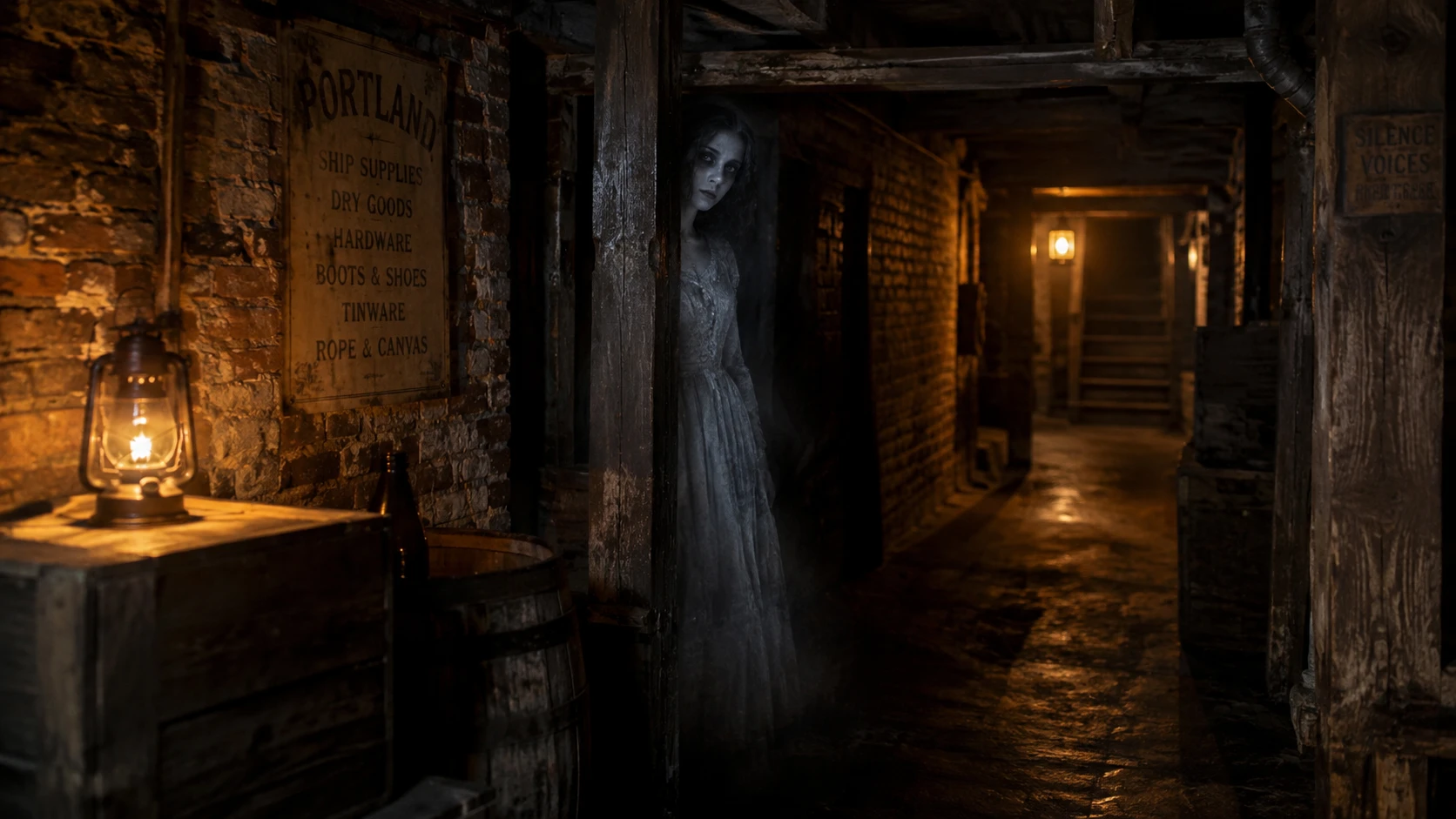
Beneath Old Town, the ghost stories get specific fast. People do not only describe a vague feeling that a basement is haunted. They remember a particular figure, a particular corner, a particular touch, or a physical reaction that stopped the moment they came back above ground.
That specificity is what makes Portland’s underground folklore so effective. The setting already has old brick, former hotels, saloons, service corridors, basement rooms and waterfront history. Then somebody says they saw a bartender where no bartender should have been — or a woman’s face peeking from behind a post — and the story has somewhere to live.
The accounts below are preserved as visitor stories and local folklore. They are not scientific evidence that ghosts or paranormal activity exist. The supernatural elements are unverified; the interest here is in what people say they experienced and why the same underground spaces keep producing such vivid stories.
The bartender who never clocked out
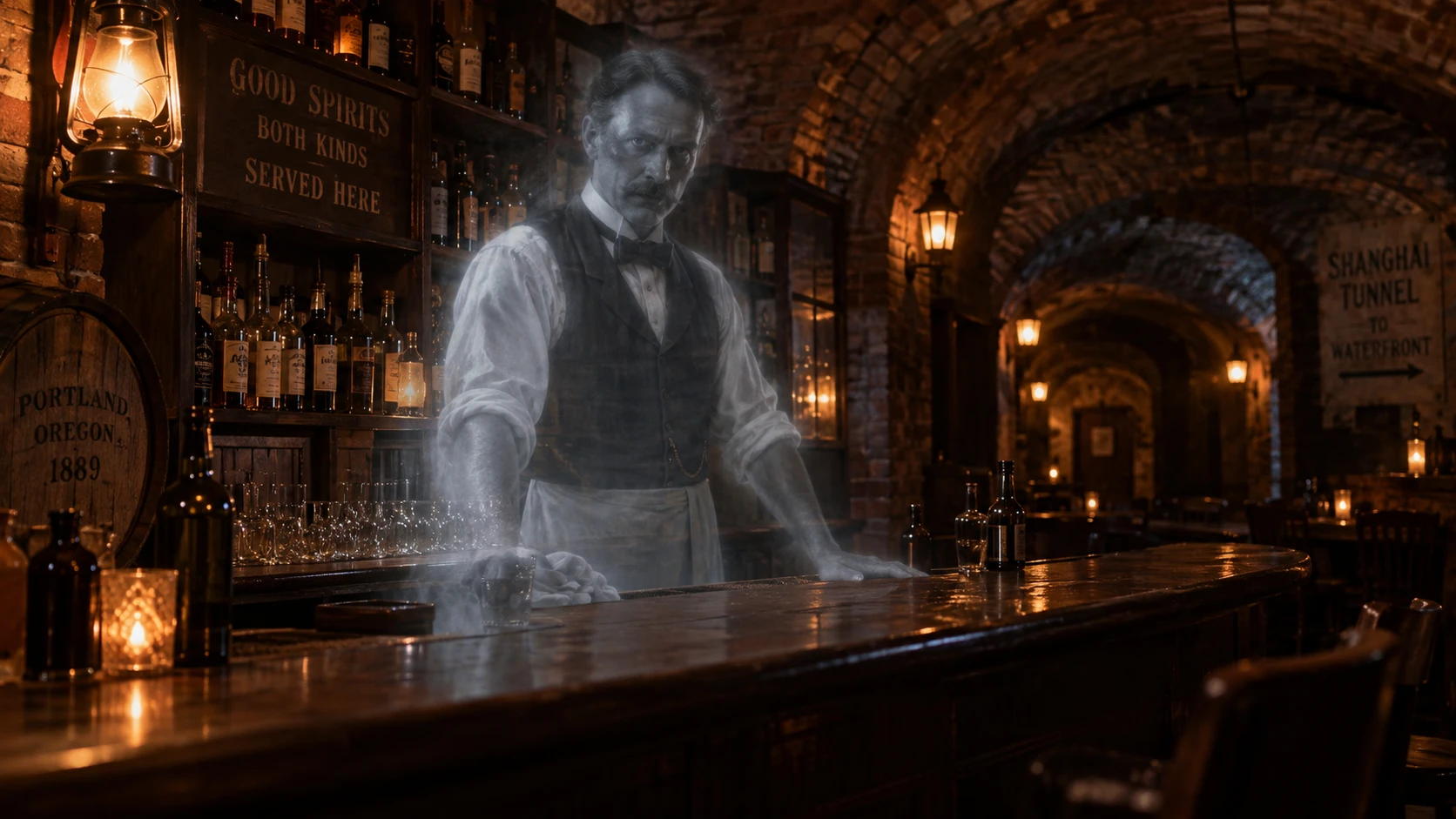
The strongest place to begin is with the figure that sounds almost too perfectly suited to Portland’s underground: the ghost bartender.
In the legend, he is not a screaming apparition racing down a hallway. He appears where a bartender belongs — behind the bar — dressed for another era and seemingly occupied with a shift that should have ended generations ago.
That ordinary behavior is what makes the story unsettling. He is not performing for the living. He is working. Some versions describe the figure standing behind the counter or appearing to tend the bar, sometimes accompanied by a sudden cold sensation or the sense that the room has changed before the figure disappears.
We gave that figure his own deep dive because the story deserves more than a passing mention: The Haunting Bartender of Portland’s Shanghai Tunnels →
The pale woman behind the post
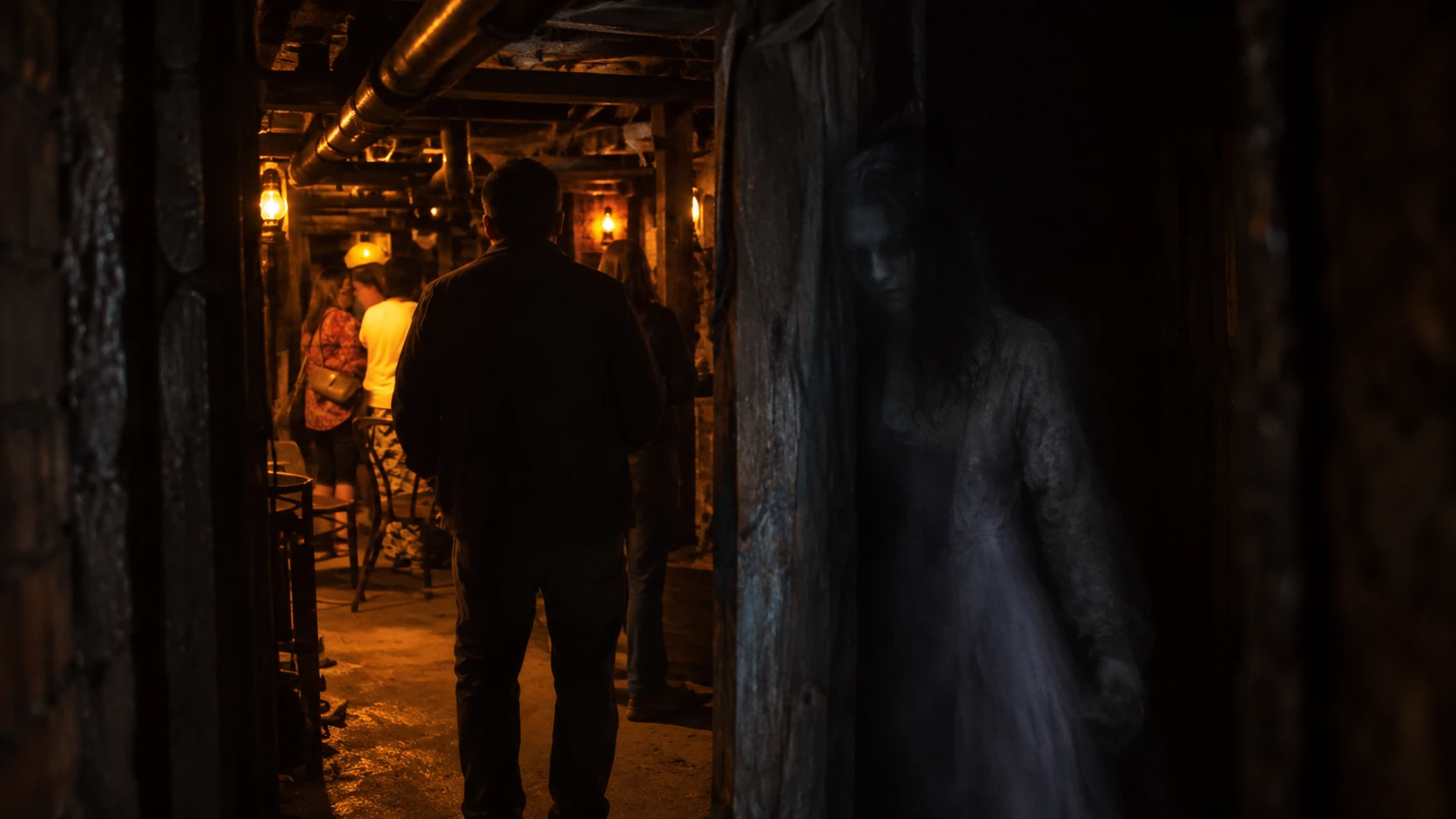
A visitor moving through the underground Shanghai Tuennels described turning a corner and catching what looked like a whitish-blue woman’s face protruding from behind a support post. The glimpse was so quick that the witness was left unsure whether they had seen something paranormal or just a strange reflection.
But the image stayed with them. That is the detail that makes the account work as a ghost story: no chase, no scream, no theatrical apparition. Just a human face in the wrong place for one beat too long. Many believe it was an appearance of Nina.
Nina: the woman said to still linger below Old Town
A separate legend attached to a widely circulated underground photograph gives one female apparition a name: Nina. In the version of the story passed around with the image, Nina is described as a prostitute who lived and worked in the Old Town world around the turn of the twentieth century.
The same telling says she died after being pushed down an elevator shaft in the old Merchant Hotel around 1900. That detail is part of the haunting lore surrounding the photograph, not a historically verified identification or documented cause of death. But it gives the apparition something more disturbing than a generic ghost story: a life, a profession, a place, and an ending.
That may be why the female figure has become one of the underground’s most memorable presences. Visitors are not simply told to watch for “a ghost.” They are given the idea of a woman who once moved through the same hotel world above them — then died violently and, according to the legend, never completely left.
Accounts connected to the tunnels describe women-shaped figures, pale faces, movement beside posts and the sensation that somebody is standing just outside the group’s light. Whether those experiences come from reflections, expectation, old architecture, photographic artifacts or something harder to explain, the Nina story gives them a face.
Watching the scene play out makes clear why this particular story sticks. The figure does not need to rush toward anyone. She only has to be visible long enough for somebody to realize that the shape in the darkness looks human — and that nobody in the group remembers seeing her walk in.
At roughly around the same time, another family’s teenage daughter became the center of the group’s attention. A photograph was said to show numerous bright “orbs” around her, while an EMF reader reportedly began behaving erratically as people asked questions aloud.
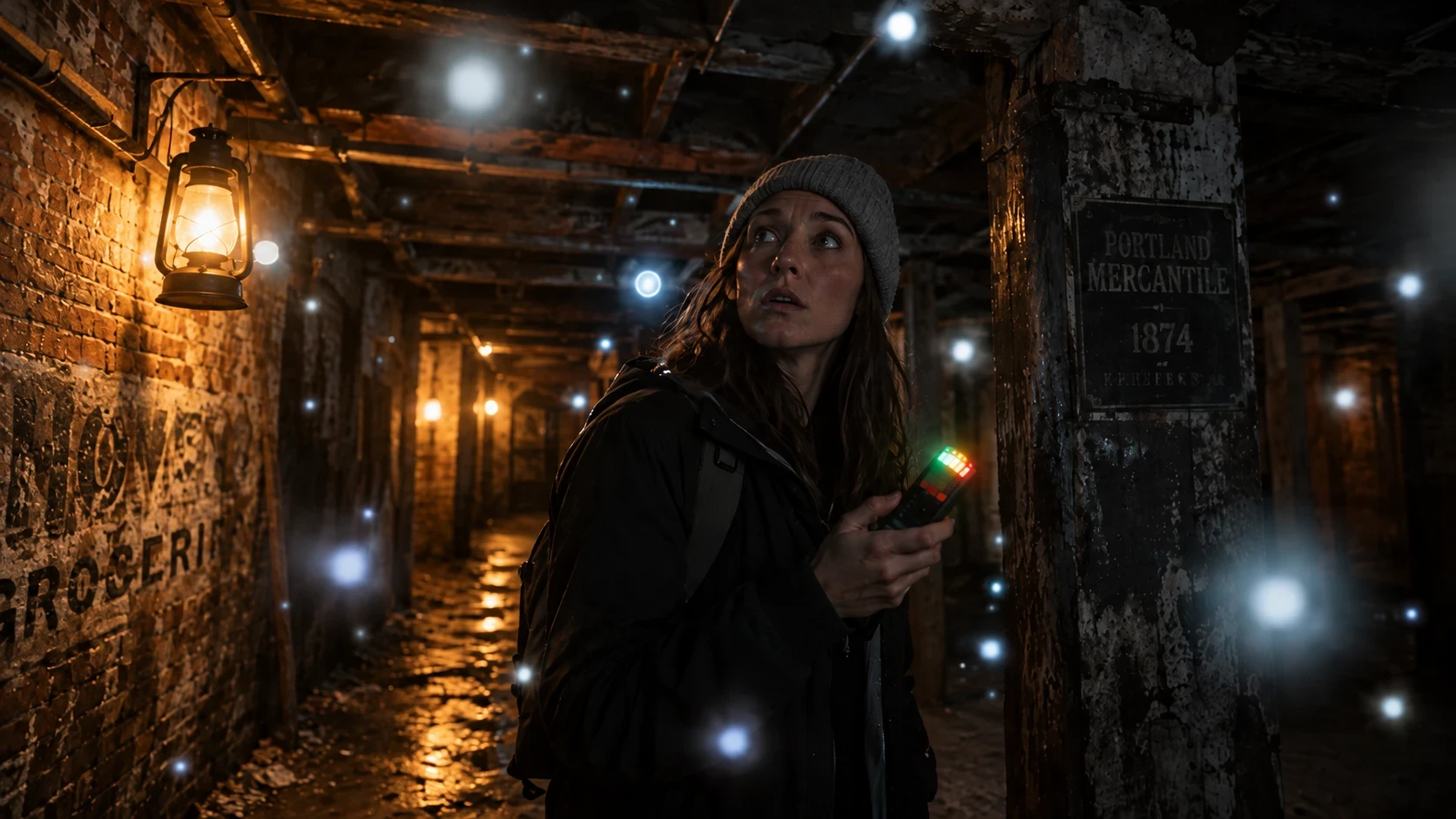
None of that establishes a supernatural cause. Old basement environments can be uncomfortable, electronic devices can react for mundane reasons, and photographs can produce dust, flare and other artifacts. But the timing was strange enough that the witness was still retelling the night years later.
The tug when nobody was there
Another visitor remembered lingering behind in one underground room after the rest of the group had moved ahead. Then came something difficult to dismiss: she felt two distinct tugs on the lower left side of her jacket.
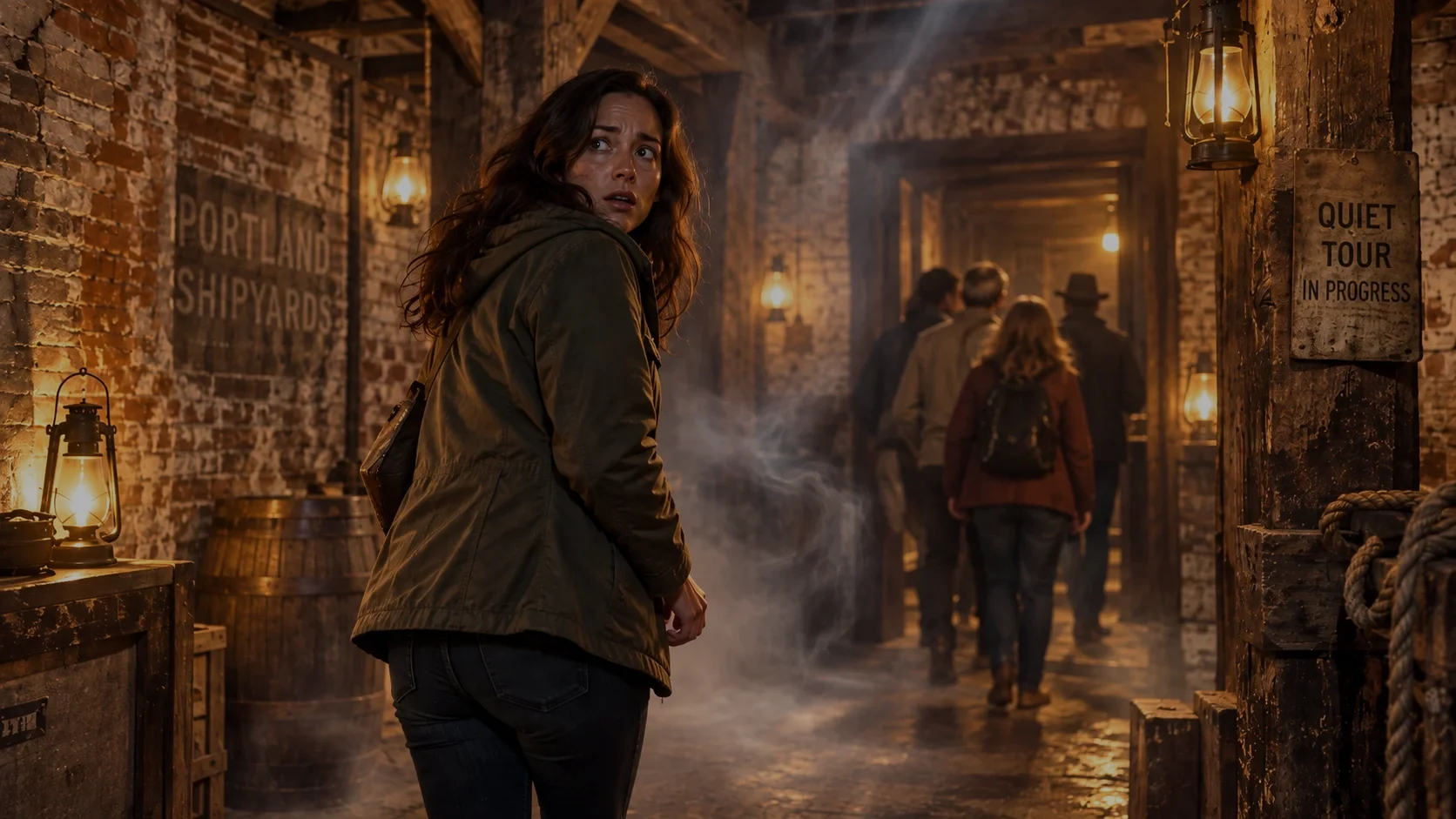
The visitor laughed and turned, assuming a brother or another member of the group was messing with them. Nobody was there. The group had already left the room.
They later described the air as heavy and the experience as strangely disorienting — as though whatever caused the tug was not trying to frighten them so much as get their attention and make them move along.
Why the underground makes these stories hit harder
Portland does not need to invent an eerie setting. It already has one.
Old Town contains real below-grade commercial spaces. The neighborhood really was connected to sailors, boarding houses, saloons, vice, river traffic and a maritime labor system capable of brutality. Shanghaiing itself was real, even though the famous trapdoor-to-tunnel kidnapping system is far more complicated historically than the legend usually suggests.
So when somebody reports a face behind a post, a bartender in an empty room, footsteps with no visible source, or fingers pulling at clothing, that report arrives in a physical environment already saturated with darker history.
Source note
Several visitor accounts summarized in this article come from a public discussion surrounding a photograph taken during an underground visit in Portland. The claims — including the name Nina, the description of her as a prostitute, and the story of a fatal elevator-shaft fall around 1900 — are preserved here as reported folklore, not independently verified historical or paranormal evidence.