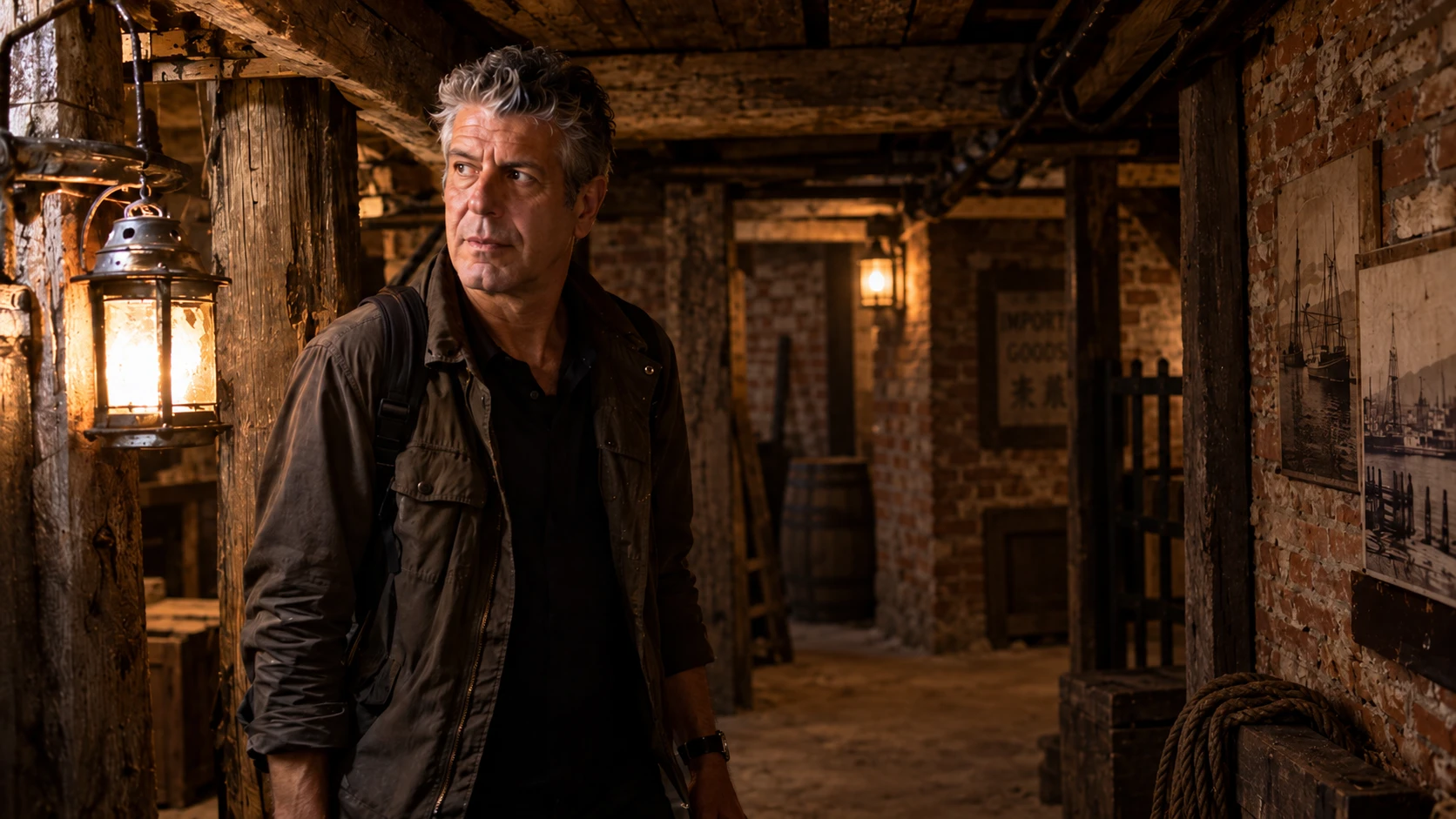
Anthony Bourdain rarely cared about the polished version of a city.
He wanted the back room. The dive. The person who had been there too long. The story locals whispered after the obvious attractions were over.
So when No Reservations came to the Pacific Northwest in 2007, Bourdain did exactly what you would expect him to do in Portland: he went underground.
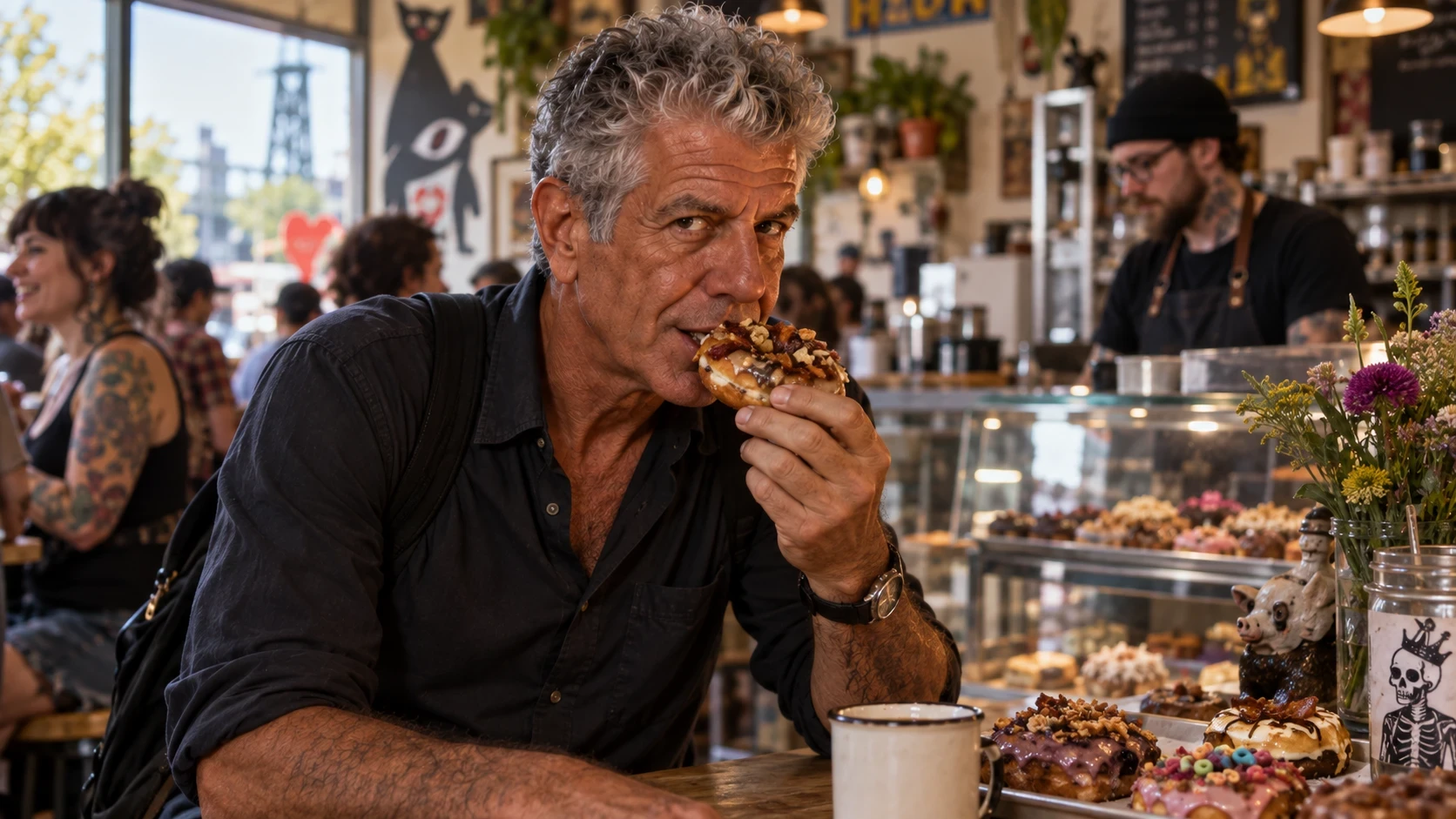
The episode is usually remembered for the food — Voodoo Doughnut, pizza, tattoos, and the peculiar culinary personality Portland was beginning to export to the rest of America. However things quickly took a turn when: Bourdain told producers he wanted to explore the history of Portland’s underground.
Michael P. Jones appears among the credited participants in the episode. Jones had spent decades associated with the modern telling of Portland’s Shanghai Tunnel story and had been leading underground tours since the late 1970s.
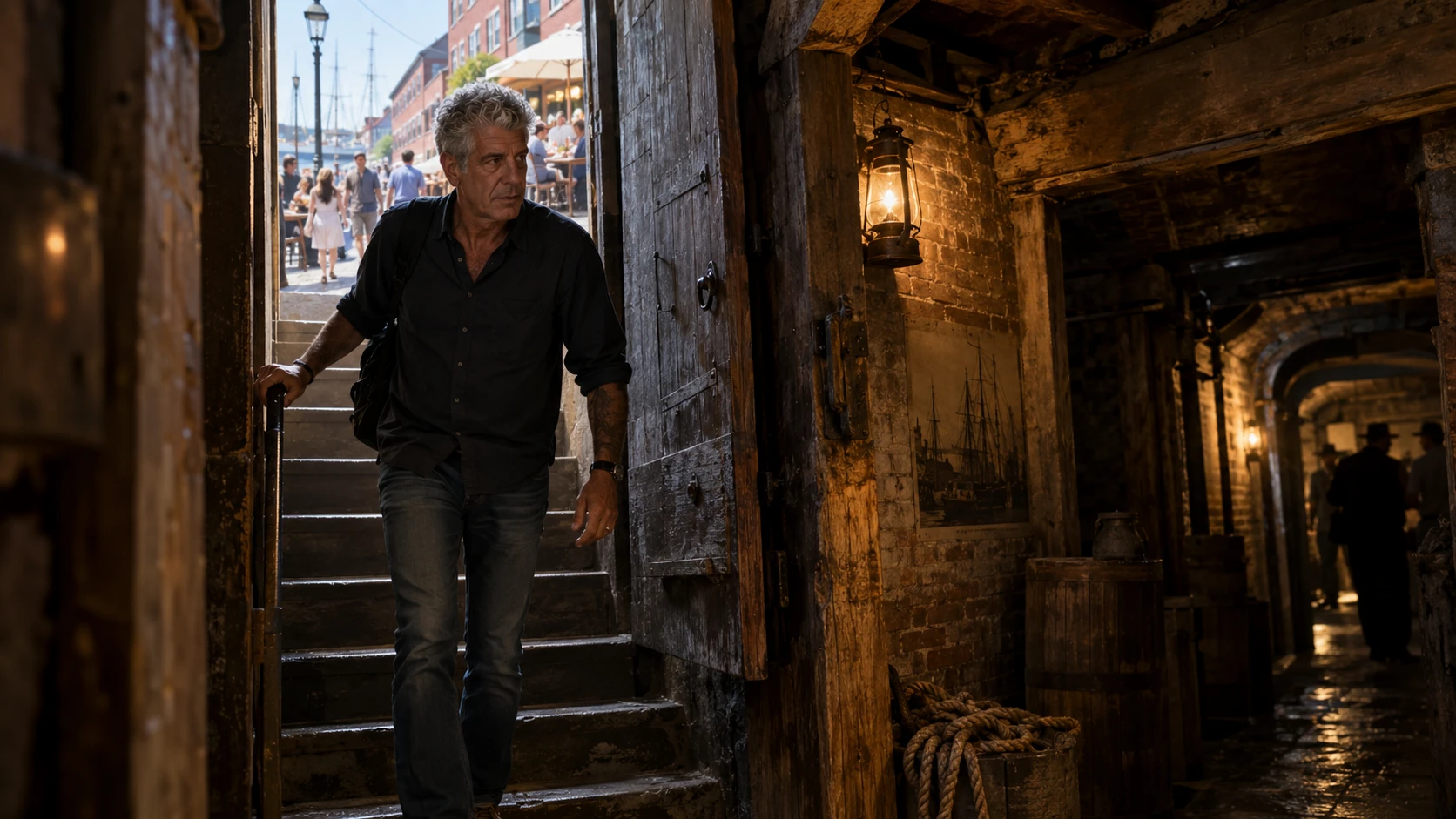
The story beneath the story
To understand why the underground mattered, you have to go back to the Portland waterfront of the late nineteenth century.
Portland was becoming a serious Pacific Coast port. Ships arrived needing cargo. They also needed crews.
And sailors had an annoying habit of leaving.
A brutal voyage around Cape Horn or across the Pacific could make disappearing into a port city look considerably better than signing up for another one.
That created an industry.
The crimps
Men known as crimps supplied sailors to ship captains. Sometimes that meant recruiting. Sometimes it meant debt, deception, alcohol, coercion or outright kidnapping.
A man delivered to a ship could be worth a fee. The payment was sometimes called blood money.
Portland was not unique. Shanghaiing and crimping were notorious throughout Pacific ports, especially San Francisco, Puget Sound and the Columbia River.
But Portland built one of the most enduring legends around it.
Then came the tunnels
Beneath Old Town were real basements, utility spaces and passageways. Buildings used below-grade areas for storage, moving merchandise, gambling, vice and ordinary commercial purposes.
Eventually those spaces became fused with the Shanghaiing story.
The popular version is cinematic: men are drugged in saloons, dropped through trapdoors, dragged through hidden tunnels, imprisoned beneath the city, and delivered secretly to ships on the Willamette River.
It is a hell of a story.
It is also where history becomes folklore.
Historians broadly agree that crimping and Shanghaiing occurred in Portland. What remains disputed is the later claim that a vast purpose-built tunnel network was routinely used to carry kidnapped sailors beneath the city. The underground spaces are real; the full tunnel mythology is much harder to prove.
How a real crime became a Portland myth
The legend did not appear fully formed.
In the 1930s, journalist Stewart Holbrook wrote romanticized stories about Portland’s rough waterfront and Shanghaiing era.
Decades later, Michael P. Jones explored Old Town basements and publicly connected the underground spaces to those Shanghaiing stories. By the 1970s, the modern idea of the Portland Shanghai Tunnels had taken shape.
Crimping and Shanghaiing are real.
Portland’s port economy creates demand for sailors, and coercive recruitment becomes part of maritime life.
The stories get bigger.
Stewart Holbrook publishes colorful accounts of Portland’s Shanghaiing era in the Sunday Oregonian.
The underground becomes the legend.
Old Town basement exploration and public tours help crystallize the modern Shanghai Tunnel narrative.
Bourdain takes the story national.
No Reservations brings Portland’s underground history into a major travel television series.
Why Bourdain belonged down there
Bourdain’s best work was rarely about food alone.
Food was the door.
Behind it were labor, poverty, migration, vice, obsession, violence, class and the stories cities tell about themselves.
Portland’s Shanghai Tunnel mythology hits nearly all of those themes.
The story begins with sailors as labor. It moves through saloons and waterfront crime. It becomes civic folklore. Then tourism. Then television.
By the time Bourdain arrived, the underground had become something larger than the physical basements beneath Old Town.
It had become part of Portland’s identity.
Bourdain understood the assignment
Plenty of television hosts could have come to Portland, eaten a doughnut and gone home.
Bourdain went downstairs.
That was the point.
The best cities have two versions: the one printed in the visitor guide, and the one you find after somebody opens the wrong door.
Portland’s wrong door happened to lead underground.